Why doesn’t everyone love reading ebooks?

We are all being sucked into a vortex of teenie weenie technology, not of our own making. Reading books is not exempt from this phenomenon and somehow readers, publishers and booksellers need to take account of it. Caroline Myrberg‘s article discusses in detail how we might improve things to make the transition from paper to digital smoother.

Why do many students still prefer paper books to e-books?
This article summarizes a number of problems with e-books mentioned in different studies by students of higher education, but it also discusses some of the unexploited possibilities with e-books.Problems that students experience with e-books include eye strain, distractions, a lack of overview, inadequate navigation features and insufficient annotation and highlighting functionality. They also find it unnecessarily complicated to download DRM-protected e-books.
Some of these problems can be solved by using a more suitable device. For example, a mobile device that can be held in a book-like position reduces eye strain, while a device with a bigger screen provides a better overview of the text. Other problems can be avoided by choosing a more usable reading application. Unfortunately, that is not always possible, since DRM protection entails a restriction of what devices and applications you can choose.
Until there is a solution to these problems, I think libraries will need to purchase both print and electronic books, and should always opt for the DRM-free alternative. We should also offer students training on how to find, download and read e-books as well as how to use different devices.

Introduction

Two years ago my colleague Ninna Wiberg and I wrote an article about reading and learning on screen as compared to print.1 According to the studies we referred to in that article, there was no substantial difference between print and screen when it came to reading comprehension and study results. But there was still a strong preference for print, which I found interesting and wanted to know more about.

Most people are prepared to agree that there are some obvious advantages to e-books. They appreciate that it is easy to carry a lot of e-books, that they are able to change font size and search within the text, and that they have instant access to e-books regardless of time and space. E-books can also easily be updated, and sometimes they contain embedded dictionaries and vocabularies. But, if e-books have all these advantages and reading from screens does not impair study results – why does everyone not prefer e-books?

Many bibliophiles love the object just as much as the written content

… they like the feel of the paper as they turn the pages, and, when they have finished the book, they want to put it in their bookcase, which doubles as a showcase of their identity.2

We know that this kind of emotional attachment to print books can affect the users’ attitudes to e-books negatively,3 but in this article I will try to look beyond the emotional aspects and present some of the more objective difficulties that users, especially students in higher education, experience when they read e-books. I will begin with a discussion of the devices used for reading e-books. Then I will discuss the problems with current e-books regarding usability and user experience. Finally, I will mention some new and innovative e-book features that could make the e-reading experience more attractive, and make a couple of suggestions of what we librarians could do to help our users here and now. This article is based on current research as well as my own observations.

The kind of device you use matters: eye strain

Many e-book readers report that they suffer from eye strain.4, 5 But here it is important to remember that there is an abundance of different screens and devices, and that screen size and quality have improved in recent years, because the kind of screen you use when you are reading matters.6 And, since the development of screens is still in progress – there is, for example, a Japanese research team that developed an eye-friendly screen prototype for e-book reading in 20167 – it is probable that screens will be even better in the future than those found today.

Aside from screen quality, the angle of inclination is also important when it comes to avoiding eye strain. A German research team has shown that, when you hold your screen in a book-like position (they used iPads in their experiment), the differences in eye strain symptoms between screen and print were eliminated. I think this shows there is a need for more user-friendly ways to read e-books on hand-held devices like tablets or e-book readers in preference to desktop or laptop computers.8

What devices do students use for e-book reading?

In some recent surveys from Finland,9 Slovenia,10 the UK11 and the US,12 students in higher education were asked what kind of devices they use when they read e-books. The numbers are not entirely comparable, since the question in the Finnish survey was about any kind of e-books, and not specifically e-textbooks as it was in the other three surveys. And the Finnish students could not specify whether they read e-books on a laptop or desktop computer. Despite these discrepancies, I have put the results from all four surveys into the same chart (see Figure 1) to get a better overview of the results.

 Original | PPT

Figure 1  Comparison of devices used by students in Finland, Slovenia, the UK and the US when they read e-books

As we can see in Figure 1, most students read e-books on their computers, usually laptops, but they do not use smartphones and tablets to the same extent.13, 14, 15, 16 There are some possible reasons why they do not use mobile devices for e-book reading, but the reasons are probably not the same for smartphones and tablets, which I will return to later.

What devices do they own?

Figure 2 shows statistics of the share of the Swedish population of different ages who have access to their own smartphone, computer or tablet.17

 Original | PPT

Figure 2  Share of the Swedish population of different ages who have access to a smartphone, their own computer or their own tablet

Almost everyone aged 16 to 35 has a smartphone, but only around 40% own a tablet. This means that the share of the younger Swedish population that owns a tablet is roughly the same as the share of students in our neighbouring country, Finland, who use tablets for e-book reading. I would therefore speculate that most students who actually own a tablet also use it for reading e-books.

Since the proportion of the population that owns a tablet is getting bigger every year, as we can see in Figure 3,18 I do not think we should neglect the tablet as a reading device. The smartphone, on the other hand, does not seem to be students’ first choice, which is probably related to the problems users experience when they read on small screens.

 Original | PPT

Figure 3  Development of the share of the Swedish population (12+ years) who have their own tablet

Reading on small screens (3.5-inch) or bigger screens with fixed layout

In a thesis from 2013 about reading on small screens19 – in which the author used the first-generation iPhone with its 3.5-inch screen – a majority of the comments were complaints about the lack of overview and difficulties in previewing and back-tracking within the text. The study subjects also pointed out that it is harder to browse back to an exact position in the book on a small screen, because then the text is fragmented over several pages. With a more fragmented text also comes a need to turn the pages more often, in this case so often that it was considered a problem. Some participants solved this problem by reducing the font size, while others preferred the bigger font size, since it made the text more legible. And even when the small screen did not have any negative effect on reading comprehension, the participants in this study still preferred a larger screen.

Another study20 shows that, as long as the text presentation is identical, there are no significant differences between reading print and reading electronic books. It is when the text is fragmented over several screens so there is less content on each screen that text processing is impaired – because, then it is more difficult for the reader to construct a cognitive map of the text structure that usually helps them remember what they are reading. Based on their findings, the authors suggest that the future design of reading devices should follow the codex structure, with a fixed layout, not only because it supports the construction of a cognitive map, but also because then it would be easier for readers who are already familiar with print books to read electronic texts more intuitively.

Based on these two studies, we can conclude that, when we read e-books, they should be as book-like as possible, and that we should read them on a screen that can display enough content and still have a font size that is large enough to be legible.

Readability

Aside from the question of whether you should offer the reader a fixed layout, or the ability to adjust the text settings, there are also other design elements that affect readability, such as the choice of type face.

a sans serif typeface was found to be more readable

I have found a couple of articles where researchers have used eye-tracking devices to compare the readability of different type faces on screens.21, 22 In both articles, a sans serif typeface was found to be more readable, which means that study subjects read both faster and more accurately than when they read texts on screens with the serif typefaces that are most commonly used in printed books. One of the studies23 also discovered that reading speeds increased even more when the font size was increased.

But how many vendors offer our users electronic books and articles that are actually designed for electronic use, and are not just an exact copy of the print original?

Usability

When it comes to the usability of e-textbooks, the majority of the students’ complaints seem to be related either to the highlighting and annotation functionality or to the overview of the content and the ability to navigate easily within the book.24, 25

Navigation

The lack of overview when you read a book on a digital device does not only make it hard to jump forwards or backwards in the text, it also gives you poor feedback on the progress you are making as you are reading. And it makes it difficult for you to plan your reading, since there is no easy way for you to see how much there is left of the book or chapter you are reading.

Highlighting and annotating

Students need to actively engage with their texts in order to learn and retain information, and they often use highlighting and annotation to do so. I have found articles from several countries26, 27, 28, 29, 30 in which university students prefer print because of the lack of possibilities for highlighting and annotating when they are reading digital texts.

In a Finnish survey from 2016,31 the majority of the students agree that the ability to highlight and annotate in e-books is important (see Figure 4).32 Since they also want to be able to download their books to their own devices (see Figure 5),33 I think we can assume that it is necessary for them to be able to highlight and annotate both online and after downloading.

 Original | PPT

Figure 4  Finnish students’ views on the importance of a digital highlighting and annotation feature

 Original | PPT

Figure 5  Percentage of Finnish students who would like to be able to download e-books onto their own devices

We know now that students want to be able to highlight and annotate, but how much do they actually use these functionalities?

In a study from 2015,34 a majority of Portuguese university students disagreed with the statement ‘I usually highlight and annotate my electronic readings’, while they agreed or strongly agreed with the statement ‘I usually highlight and notate my printed course readings’ (see Figure 6). And in Figure 7 we can see that the result was similar when the same survey was carried out in the UK last year.35 In both countries, students usually highlight and annotate more when they read print than when they read electronic texts.36, 37

 Original | PPT

Figure 6  Comparison of the number of students (Portugal, 2015) who highlight and annotate electronic and print reading matter

 Original | PPT

Figure 7  Comparison of the number of students (UK, 2016) who highlight and annotate electronic and print reading matter

The authors of the UK study suggest that students need more training on how to use applications for learning purposes, since they have found that ‘there is a perceived greater difficulty associated with highlighting and annotating in electronic formats’.38 And I think they have a point, since many students are not even aware that they can annotate and highlight in their e-books, but I also think we need to make certain that our e-books actually provide the functionality to annotate and highlight.

Accessibility: DRM

The main issue when it comes to accessibility and e-books is digital rights management (DRM) protection. DRM involves technological restrictions that make it possible to control what users can do with our e-resources.39

In the Finnish study from last year,40 college and university students said that they do not want to have to log in several times or use separate applications in order to borrow e-books. They want to be able to borrow the e-books when they need them and keep them as long as they need to, and they want to be able to download the e-books for offline reading regardless of what device or web browser they are using. In other words, they want to be able to do everything that DRM protection restricts them from doing.

It is probably not reasonable to suggest that all library books should be DRM-free (even if the music industry experienced increased sales when they removed DRM protection).41 But it is not just easier for the user to download DRM-free e-books – when you download an e-book without DRM you are also free to choose the device and application most suitable for your needs.

As we have seen, the best device for reading e-books is not a computer, but rather a slightly bigger mobile device. But what happens when we try to read an e-book from, for example, Ebook Central, on our tablets?

If you read a book on Ebook Central’s online platform in a browser on a mobile device, you will find that you cannot use the touch screen to select text, which in turn makes it impossible to highlight text. And it does not help if you download the book for offline reading to Bluefire Reader (which is the default application), because it is not possible to select text for highlighting there either. But, even if you do manage to open the book in another application with better functionality for highlighting and annotating, as soon as the loan expires, the notes will be gone for good.

If our suppliers are unable to remove the DRM protection from their books, could they not at least have a default reading application that is better suited to our students’ needs? Perhaps they could make it possible for the users to get their notes and highlights back when they borrow the book again?

Distractions

Many users admit that they easily get distracted when they read e-books,42, 43 which I think should be possible to remedy even if you are slightly addicted to the dopamine that your brain produces every time you hear a ping from your device.44 You could, for example, choose to turn off some of the notifications on your device, or even turn on flight mode when you need to be completely undisturbed. But I have often wondered why every e-book reader application does not have an optional ‘do not disturb’ function similar to Kobo’s ‘Reading Mode’ or Kindle Fire’s ‘Quiet Time’,45 that automatically turns off all alerts from selected applications while you are reading.

A device that is usable by our students?

Is there any device on the market today that meets all our students’ needs? A device that is mobile/hand-held, without any distractions, not too small and comes with a pen you can use to make handwritten notes, since handwriting aids the memory better than typing?46

I think a tablet like the new ‘paper tablet’ reMarkable47 might be interesting to students who want to benefit from the advantages of e-books without losing all the familiar characteristics of paper, even if the first generation of this tablet unfortunately does not support DRM. The reMarkable tablet is about A4 size with an e-ink screen with ‘paper feel’ and a pen, and you can use it only for reading, writing and sketching. You can transfer documents between the tablet and your computer, but apart from that it has no connection with the outside world that can distract you while you are reading.

Applications with exemplary functionality

There are applications today that offer better functionality for highlighting and annotation than Bluefire Reader, and much better navigation functionality that, at least partly, compensates for the lack of spatial landmarks that we are used to from print books. LiquidText and the Kindle application are a couple of examples of applications that I think have some excellent features, even if they do not support Adobe DRM.

LiquidText48 is a PDF reader that has a kind of extra margin space beside the text where you can make annotations. Instead of just highlighting text passages, you can pull them out of the document into the margin, where you can organize them with your own notes. And you just need to tap a text passage to get back to the source.

The Kindle application has outstanding navigation features. Page Flip49 is a speed-browsing function that enables you quickly to swipe past lots of pages and then instantly jump back to where you were by clicking on the little ‘current page’ thumbnail which is always pinned to the side of the screen. This is perfect if, for example, you want to find a page that you remember the look of, or if you want to explore ahead to see how much there is left of a chapter.

Another nice thing with the Kindle application is that it always shows you where you are in the book without having to click anywhere first. In the bottom right-hand corner you will always see how much of the whole book you have read, and in the bottom left-hand corner you can choose between the number of pages you have read so far and how much time it would take you to finish the current chapter or the whole book.

These are a couple of examples of applications that have done more to meet our needs than most. And LiquidText has even taken a step further and created new, useful functionalities that do not have any equivalents in the paper world.

E-book design

Earlier I referred to authors who think that the best way to read e-books is to read those that are as book-like as possible. And, since most e-books today are just electronic copies of print books with linear text, that perception makes perfect sense.

But what would happen if publishers started to think outside the box a little?

But what would happen if publishers started to think outside the box a little? What would happen if they created the e-book first and let it utilize all the possibilities that the electronic medium offers?

Not just a copy of the print edition

There are some good examples of e-book design where the e-books are not just a direct copy of a print original. The annual report ‘Swedes and the Internet’50 is one of them. It can be downloaded as a PDF that looks like an ordinary, classical, linear book with its usual table of contents, which is preferable if you want to read the entire report from cover to cover.

The same report is also available as a website,51 where you can use tags to find the content you are interested in. This web version is very handy if you are only interested in parts of the report, but hopeless if you want to read the entire book – or print it out.

So much more than the print edition

When you read the iPad application edition of T S Eliot’s The Waste Land from Touch Press52 you cannot smell the book, nor can you feel the pages as you turn them. Instead, you can listen to the author reading his own work, or watch the actress Fiona Shaw perform the poem synchronized to the text – all the time with access to detailed notes. And, if you still do not understand the poem’s many references and allusions, there are 35 expert interviews included in the application that you can watch. What literature student would not prefer this application to the print book?

How can librarians add value here and now?

Until all students have a suitable device that they are familiar with and that offers a smooth reading experience, we need to offer training on how to find, download and read e-books as well as how to use different devices.

I also think it would be of use to our students if we always purchased the DRM-free e-book when available, and that we sometimes still need to purchase both the print and the electronic book, because, even if e-books have many advantages, sometimes you just might still prefer a print book.

Abbreviations and Acronyms

A list of the abbreviations and acronyms used in this and other Insights articles can be accessed here – click on the URL below and then select the ‘Abbreviations and Acronyms’ link at the top of the page it directs you to: https://www.uksg.org/publications#aa

Competing interests

The author has declared no competing interests.

This thoughtful, intelligent article first appeared in UKSG Insights on 8th November 2017, under the Creative Commons 4.0 Attribution licence, and is reproduced here in its entirety. 

How to Cite: Myrberg, C., (2017). Why doesn’t everyone love reading e-books?. Insights. 30(3), pp.115–125. DOI: https://doi.org/10.1629/uksg.386

References

  1. Myrberg, C and Wiberg, N (2015). Screen vs. paper: what is the difference for reading and learning?. Insights 28(2): 49–54, DOI: https://doi.org/10.1629/uksg.236 (accessed 18 September 2017). 
  2. Ketron, S and Naletelich, K (2016). How e-readers have changed personal connections with books. Qualitative Market Research: An International Journal 19(4): 433–52, DOI: https://doi.org/10.1108/QMR-10-2015-0078 (accessed 18 September 2017). 
  3. Waheed, M, Kaur, K, Ain, N and Sanni, S A (2015). Emotional attachment and multidimensional self-efficacy: extension of innovation diffusion theory in the context of eBook reader. Behaviour & Information Technology 34(12): 1147–59, DOI: https://doi.org/10.1080/0144929X.2015.1004648 (accessed 18 September 2017). 
  4. Mizrachi, D (2015). Undergraduates’ Academic Reading Format Preferences and Behaviors. The Journal of Academic Librarianship 41(3): 301–11, DOI: https://doi.org/10.1016/j.acalib.2015.03.009 (accessed 18 September 2017). 
  5. Ríos Amaya, J and Secker, J (2016). Choosing between print and electronic … Or keeping both? Academic Reading Format International Study (ARFIS) UK Report. London: Learning Technology and Innovation (LTI). https://eprints.lse.ac.uk/67028/ (accessed 4 October 2017). 
  6. Hou, J, Rashid, J and Lee, K M (2017). Cognitive map or medium materiality? Reading on paper and screen. Computers in Human Behavior 67: 84–94, DOI: https://doi.org/10.1016/j.chb.2016.10.014 (accessed 18 September 2017). 
  7. Kubota, D, Niikura, Y, Hatsumi, R, Hirakata, Y, Miyake, H, Yamazaki, S, Chubachi, Y and Katayama, M (2016). Reflective LCD with high reflectance and color reproducibility for reduced eye strain. Journal of the Society for Information Display 24(3): 168–76, DOI: https://doi.org/10.1002/jsid.426 (accessed 18 September 2017). 
  8. Köpper, M, Mayr, S and Buchner, A (2016). Reading from computer screen versus reading from paper: does it still make a difference?. Ergonomics 59(5): 615–32, DOI: https://doi.org/10.1080/00140139.2015.1100757 (accessed 18 September 2017). 
  9. Mikkonen, P and Peltonen, I (2016). E-book Survey for Higher Education Students and Teachers in Finland. Helsinki: Finelib. https://www.kiwi.fi/display/finelib/Project%3A+E-textbooks+for+Finnish+HE (accessed 18 September 2017). 
  10. Zabukovec, V and Vilar, P (2015). Kurbanoglu, S, Boustany, J, Špiranec, S, Grassian, E, Mizrachi, D and Roy, L eds.  Paper or Electronic: Preferences of Slovenian Students. Information Literacy: Moving Toward Sustainability 552: 427–35, DOI: https://doi.org/10.1007/978-3-319-28197-1_43 (Communications in Computer and Information Science) (accessed 4 October 2017). 
  11. Ríos Amaya, J and Secker, J ().  ref. 5. 
  12. Mizrachi, D ().  ref. 4. 
  13. Mikkonen, P and Peltonen, I ().  ref. 9. 
  14. Zabukovec, V and Vilar, P ().  ref. 10. 
  15. Ríos Amaya, J and Secker, J ().  ref. 5. 
  16. Mizrachi, D ().  ref. 4. 
  17. Davidsson, P and Findahl, O (2016). Svenskarna och internet 2016: Undersökning om svenskarnas internetvanor In: Stockholm: Internetstiftelsen i Sverige. https://www.iis.se/docs/Svenskarna_och_internet_2016.pdf (accessed 22 September 2017). 
  18. Davidsson, P and Findahl, O ().  ref. 17. 
  19. Tikka, P (2013). Reading on small displays: reading performance and perceived ease of reading, doctoral thesis. Newcastle: Northumbria University. https://nrl.northumbria.ac.uk/id/eprint/14788 (accessed 18 September 2017). 
  20. Hou, J, Rashid, J and Lee, K M ().  ref. 6. 
  21. Franken, G, Podlesek, A and Možina, K (2015). Eye-tracking Study of Reading Speed from LCD Displays: Influence of Type Style and Type Size. Journal of Eye Movement Research 8(1)DOI: https://doi.org/10.16910/jemr.8.1.3 (accessed 18 September 2017). 
  22. Dogusoy, B, Cicek, F and Cagiltay, K (2016). Marcus, A ed.  How Serif and Sans Serif Typefaces Influence Reading on Screen: an Eye Tracking Study. Design, User Experience, and Usability: Novel User Experiences. DUXU 2016 9747: 578–86, DOI: https://doi.org/10.1007/978-3-319-40355-7_55 (Lecture Notes in Computer Science), (accessed 18 September 2017). 
  23. Franken, G, Podlesek, A and Možina, K ().  ref. 21. 
  24. Ketron, S and Naletelich, K ().  ref. 2. 
  25. Mikkonen, P and Peltonen, I ().  ref. 9. 
  26. Mikkonen, P and Peltonen, I ().  ref. 9. 
  27. Zabukovec, V and Vilar, P ().  ref. 10. 
  28. Ríos Amaya, J and Secker, J ().  ref. 5. 
  29. Mizrachi, D ().  ref. 4. 
  30. Wang, S and Bai, X (2016). University Students Awareness, Usage and Attitude Towards E-books: Experience from China. The Journal of Academic Librarianship 42(3): 247–58, DOI: https://doi.org/10.1016/j.acalib.2016.01.001 (accessed 18 September 2017). 
  31. Mikkonen, P and Peltonen, I ().  ref. 9. 
  32. Mikkonen, P and Peltonen, I ().  ref. 9. 
  33. Mikkonen, P and Peltonen, I ().  ref. 9. 
  34. Terra, A L (2015). Kurbanoglu, S, Boustany, J, Špiranec, S, Grassian, E, Mizrachi, D and Roy, L eds.  Students’ Reading Behavior: Digital vs. Print Preferences in Portuguese context. Information Literacy: Moving Toward Sustainability 552: 436–45, DOI: https://doi.org/10.1007/978-3-319-28197-1_44 (Communications in Computer and Information Science series), (accessed 18 September 2017). 
  35. Ríos Amaya, J and Secker, J ().  ref. 5. 
  36. Terra, A L ().  ref. 34. 
  37. Ríos Amaya, J and Secker, J ().  ref. 5. 
  38. Ríos Amaya, J and Secker, J ().  ref. 5. 
  39. van Arnhem, J P and Barnett, L (2014). Is Digital Rights Management (DRM) Impacting E-Book Adoption in Academic Libraries?. The Charleston Advisor 15(3): 63–5, DOI: https://doi.org/10.5260/chara.15.3.63 (accessed 18 September 2017). 
  40. Mikkonen, P and Peltonen, I ().  ref. 9. 
  41. van Arnhem, J P and Barnett, L ().  ref. 39. 
  42. Ketron, S and Naletelich, K ().  ref. 2. 
  43. Mizrachi, D ().  ref. 4. 
  44. Baron, N S (2015). Words onscreen: the fate of reading in a digital world. New York: Oxford University Press.  
  45. Baron, N S ().  ref. 44. 
  46. Mueller, P A and Oppenheimer, D M (2014). The Pen Is Mightier Than the Keyboard: Advantages of Longhand Over Laptop Note Taking. Psychological Science 25(6): 1159–68, DOI: https://doi.org/10.1177/0956797614524581 (accessed 18 September 2017). 
  47. reMarkable: ().  https://getremarkable.com/ (accessed 18 September 2017). 
  48. LiquidText: ().  https://liquidtext.net/product/ (accessed 18 September 2017). 
  49. Amazon.com: Page Flip: ().  https://www.amazon.com/b?node=13632018011 (accessed 18 September 2017). 
  50. Davidsson, P and Findahl, O ().  ref. 17. 
  51. Davidsson, P and Findahl, O (2016). Svenskarna och internet 2016: En årlig studie av svenska folkets internetvanor In: Stockholm: Internetstiftelsen i Sverige. https://www.soi2016.se/ (accessed 22 September 2017). 
  52. The Waste Land: ().  https://thewasteland.touchpress.com/ (accessed 18 September 2017). 

e-Textbook Sales Growing at eBooks.com

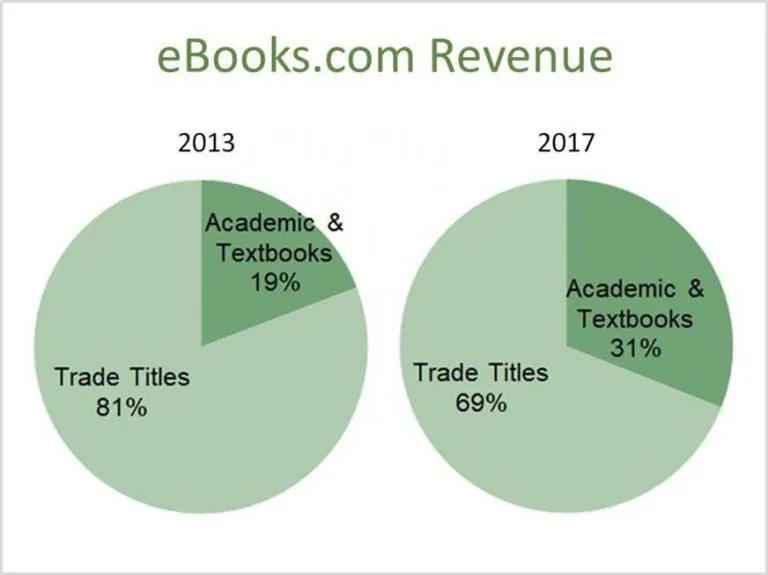
Over the last few years we’ve seen e-textbooks, as a share of eBooks.com’s revenue, grow 61%. And this without us paying particular attention to textbooks as a category.

eBooks.com’s strategic focus is on improving our customers’ experience and implementing customer-focussed communication strategies, but not specifically aimed at educators.

Nevertheless, educators around the globe are finding us in growing numbers.

This development has not gone unnoticed. At Frankfurt Book Fair in October, one educational publisher put it bluntly: “What on earth are you doing to drive all these sales?” Until she asked, we hadn’t really noticed what was going on.

I cleared my throat and explained with sweeping hand gestures that it was the result of our carefully targeted multi-channel, community focused SMM, SEM, SEO and email outreach campaigns. Most likely.

On reflection though, I think it’s a result of the simple fact that the time for e-textbooks is here.

Textbook publishing has always been a challenge.

My father once confessed to me that, when he was studying engineering in the 1940s, he availed himself of pirated versions of his course textbooks.

It took a generation for our family to recover from the shame that his admission brought on us. But there’s a message here as to why higher ed publishers have approached ebook distribution with caution. Piracy has always been a massive problem for textbook publishers, and the advent of digital distribution only raised the risks.

Flagship, cornerstone textbooks are different from consumer or general scholarly titles. To publish a trusted, solid tome called “Introducing Biology”, with engaging, full colour illustrations and pages set out like a glossy magazine involves significant investment. It can cost millions to produce, drawing on the work of teams of experts. For a higher ed publisher, testing the waters by putting a digital version out there means risking everything.

Things move on though, and higher ed publishers are increasingly embracing digital distribution, through channels like eBooks.com, VitalSource, Kortext and Bibliu.

If you’re interested in exploring opportunities in e-textbook sales, just ping me.

Stephen

Kazuo Ishiguro Wins 2017 Nobel for Literature

0

Kazuo Ishiguro has just been named as the winner of this year’s Nobel Prize for Literature

Ishiguro was born in Nagasaki, Japan, on November 8, 1954 and his family emigrated to the UK in 1960.

He is the author of a host of highly acclaimed works, including The Remains of the Day and Never Let Me Go.


  • Never Let Me Go

    In one of the most memorable novels of recent years, Kazuo Ishiguro imagines the lives of a group of students growing up in a darkly skewered version of contemporary England. Narrated by Kathy, now 31, Never Let Me Go hauntingly dramatises her attempts to come to terms with her childhood at the seemingly idyllic Hailsham School, and with the fate… more…

  • When We Were Orphans

    England, 1930s. Christopher Banks has become the country’s most celebrated detective, his cases the talk of London society. Yet one unsolved crime has always haunted him; the mysterious disappearance of his parents, in Old Shanghai, when he was a small boy. Now, as the world lurches towards total war, Banks realises the time has come for him to return… more…

  • The Unconsoled

    ‘Almost certainly a masterpiece.’ Anita Brookner Ryder, a renowned pianist, arrives in a Central European city he cannot identify for a concert he cannot remember agreeing to give. But then as he traverses a landscape by turns eerie and comical – and always strangely malleable, as a dream might be – he comes steadily to realise he is facing the… more…

  • The Remains of the Day

    ‘After all what can we ever gain in forever looking back and blaming ourselves if our lives have not turned out quite as we might have wished?’ In the summer of 1956, Stevens, the ageing butler of Darlington Hall, embarks on a leisurely holiday that will take him deep into the English countryside and into his past… A contemporary classic, The… more…

    An Artist of the Floating World

    It is 1948. Japan is rebuilding her cities after the calamity of World War Two, her people putting defeat behind them and looking to the future. The celebrated artist, Masuji Ono, fills his days attending to his garden, his house repairs, his two grown daughters and his grandson; his evenings drinking with old associates in quiet lantern-lit bars…. more…


    A Pale View of Hills

    In this debut novel from acclaimed Booker Prize-winning Kazuo Ishiguro ( The Remains of the Day , Never Let Me Go ), post-war Japan serves as the haunting backdrop to a subtle story of memory, suicide, and psychological trauma. Etsuko lives alone in rural England, trying to come to terms with the recent suicide of her daughter, Keiko. A visit from… more…


  • Nocturnes

    ‘It was our third time playing the Godfather theme since lunch…’ In a sublime short story collection, Kazuo Ishiguro explores ideas of love, music and the passing of time. From the piazzas of Italy to the Malvern Hills, a London flat to the ‘hush-hush floor’ of an exclusive Hollywood hotel, the characters we encounter range from young dreamers… more…


    The Buried Giant

    An extraordinary new novel from the author of Never Let Me Go and the Booker Prize winning The Remains of the Day ‘You’ve long set your heart against it, Axl, I know. But it’s time now to think on it anew. There’s a journey we must go on, and no more delay…’ The Buried Giant begins as a couple set off across a troubled land of mist and rain… more…

Gartner’s Hype Cycle 2017: A Familiar Curve for Ebooks

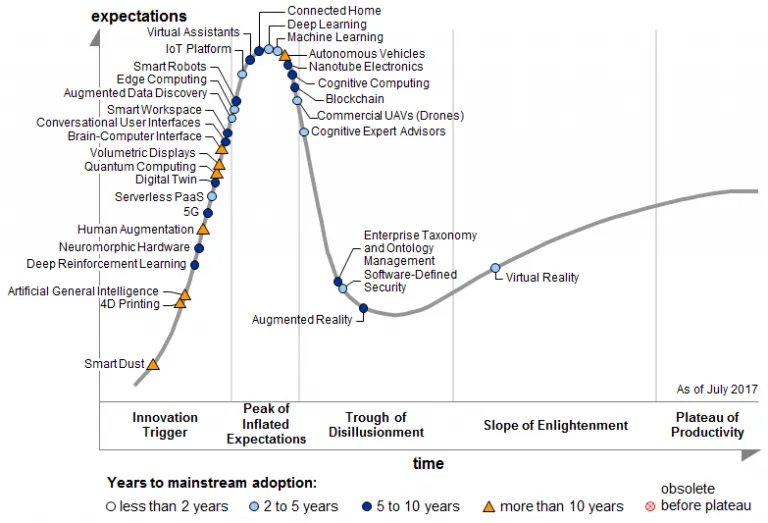
George Walkley’s excellent innovation newsletter, Inflight Engineering, just highlighted Gartner’s report, Hype Cycle for Emerging Technologies 2017. The report provides a cross-industry perspective on emerging technologies and trends. It argues that an emerging technology will typically pass through five stages before achieving broad adoption.

Here’s how Gartner explains the predictable phases of this cycle. The hype cycle drills down into the five key phases of a technology’s life cycle.

Innovation Trigger: A potential technology breakthrough kicks things off. Early proof-of-concept stories and media interest trigger significant publicity. Often no usable products exist and commercial viability is unproven.

Peak of Inflated Expectations: Early publicity produces a number of success stories — often accompanied by scores of failures. Some companies take action; many do not.

Trough of Disillusionment: Interest wanes as experiments and implementations fail to deliver. Producers of the technology shake out or fail. Investments continue only if the surviving providers improve their products to the satisfaction of early adopters.

Slope of Enlightenment: More instances of how the technology can benefit the enterprise start to crystallize and become more widely understood. Second- and third-generation products appear from technology providers. More enterprises fund pilots; conservative companies remain cautious.

Plateau of Productivity: Mainstream adoption starts to take off. Criteria for assessing provider viability are more clearly defined. The technology’s broad market applicability and relevance are clearly paying off.

The dramatic trend line in this chart certainly reflects our own experience with consumer ebooks[note]Scholarly ebooks cut a very different, more orderly trajectory[/note] over the last 17 years and leads me to think that, although the ebook might be in its Trough of Disillusionment, it is poised for sustainable growth.

There are good reasons for optimism. But first, what just happened? In the case of ebooks, the Peak of Inflated Expectations in 2014 was out of all proportion to the genuine consumer demand that existed before the Kindle came on the scene. Ninety per cent of the buzz that ebooks generated from 2008 was not generated by ebooks at all. It was paid for by Amazon.

In fact the real Peak occurred around 2001. Back then, every book fair and trade journal was crackling with hyper-expectation. Adobe, netLibrary[note]Spent $110 million between 1999 and 2001[/note] , Questia[note]$130 million[/note] , Barnes & Noble, Microsoft, Gemstar[note] Gemstar reportedly paid US$ 400 million for two nascent ebook devices in 2000[/note] and others splurged in an effort to own the promising ebook market.

But it soon became clear, especially to those who had invested in new, clumsy technologies, that people, mostly, didn’t want ebooks.

At BEA in May 2001 I met with the head of Adobe’s ebook effort. All around us were vast, glittering booths packed with bright young things in polo shirts touting their ebook solutions. I said, “Look, Tom, I think we might not be in the same league here. eBooks.com is only selling 40 ebooks a day.”

He paused and then replied, “Forty? Forty a day? Woah, no Stephen, that puts you at the top of the league.”

Until that moment, I’d assumed we were getting something wrong. Judging by the press releases, the air-punching and braggadocio of our gigantic competitors, it looked like they were flogging millions of those critters to growing hordes of avid ebook fans; fans who had overlooked eBooks.com. But no. The full horror of what was unfolding dawned on me.

I’d been embarrassed to think I’d spent $2 million of our shareholders’ cash, only to be selling a trickle of ebooks. In the same few years, the startups and behemoths had burned over a billion dollars, with little more to show. It was a shouty, bragging train wreck.

eBooks.com’s consumer sales grew from that low base in 2000 at an annual rate of 20%, relentlessly, until 2008 when we spiked significantly in the midst of another billion-dollar froth-fest.

To be continued…


Scott Uminga, Artist: Forest of Reading

0

Hi, I’m Scott Uminga from Toronto, Canada. Taurus Born.

I’m currently an Illustrator working on personal art pieces that narrate moments in my life.

I graduated from college from a Game Development program where I discovered a love of visualizing a scene. I enjoy creating images with a story, and conceptualizing characters, props, and worlds that a person can interpret. I like to brainstorm with friendly people and expand ideas to create a universe.
www.scottuminga.com

Click to enlarge

Save

Save

What we already knew: People who read books are nicer

The Independent reports the results of a recent study by Kingston University into the empathy levels of readers and non-readers, and guess what — people who read books are nicer. They just are.

This isn’t so surprising. In my years as a real-world bookseller, it really seemed that there was a sort of invisible filter in the bookshop’s doorway, keeping all but the nicest sort of people out.

The muppet filter, as it was called, occasionally failed, letting through some grumpy sociopath. But for the most part it was effective.

We had a Muppet Rule too, which helped us cope with the occasional difficult customer. Once a year — but only once — each staff member was allowed to shout bloody murder at an unkind customer. and tell them to leave. Most of us came close from time to time, but in all those years no-one actually invoked the rule.

(Stephen)

Has the print book trumped digital? Beware of glib conclusions

Nick Earls, The University of Queensland

While just a few years ago, headlines predicted eBook supremacy and the demise of the paper book, that’s now reversed. They’re now saying the Kindle is clunky and unhip and paper books are cool and selling well as eBook sales crash. But are today’s claims any more accurate than those of 2012? The Conversation

The latest round of headlines was triggered by UK Publishers’ Association figures noting a fall in consumer eBook sales of 17% in 2016, while physical book sales rose 8%. This statistic seems straightforward enough on the surface, but it pays to go deeper.

Mainstream media have long been in the habit of relying on figures from publishers’ associations, retailers’ groups and Nielsen data, but the industry has changed. While these measures are accurate, they are only accurate in terms of what they measure, and they represent far less of the industry than they once did. They are no longer a proxy for the industry.

A recent history of eBooks

Amazon’s Kindle was launched in November 2007. Barnes & Noble followed with their Nook in October 2009 and Kobo with their eReader in May 2010. Apple’s launch of the iPad in January 2010, meanwhile, introduced a non-specialist device that gave a pleasing eReading experience. US eBook sales rose 1260% between 2008 and 2010. By early 2011, US advisory group Gartner reported that industry researchers were predicting a 70% annual growth rate for eReader sales globally.

In February that year, the REDgroup, the parent company of Angus&Robertson and Borders in Australia – chains responsible for 20% of the country’s book sales – went into receivership. Retailers across the industry in Australia were noticing a downturn. After 5% growth in 2009, Australian book sales contracted slightly in 2010, then dramatically in 2011, with falls of 13% in volume and 18% in value, and significant falls continuing into 2012.

In January 2011, Amazon announced that, for the first time, it was selling more eBooks than paperbacks. According to Nielsen figures, US eBook sales went from US$69m in 2010 to US$165m in 2011, a 139% increase. They increased a further 30% in 2012 and 13% in 2013.

Nielsen figures, though, only record sales of books with ISBNs, something many independently published eBooks do not have. Despite not counting many eBooks, Nielsen still recorded sales as increasing, albeit probably at diminishing growth rates each year.

In January 2011, Amazon announced that, for the first time, it was selling more eBooks than paperbacks.
Artem Evdokimov/shutterstock

With increases in both average smartphone screen size and smartphone use, the 2014 to 2015 period marked another shift – the phone was becoming a significant reading tool. According to US Nielsen surveys, while the percentage of the eReading population reading primarily on tablets had increased from 30% in 2012 to 41% in 2015, the number of eBook buyers who used their phones to read at least some of the time increased from 24% to 54% in the same period.

Judith Curr, publisher of Atria Books, stated in 2015 that,
“The future of digital reading is on the phone. It’s going to be on the phone and it’s going to be on paper”.

Peak eBook?

EBook sales in the US, though, appeared to plateau at 2013 levels, according to Association of American Publishers figures, and then dipped early in 2015. In the UK, the Publishers’ Association reported digital sales for the year 2015 falling slightly and print sales growing minimally. “Readers take a pleasure in a physical book that does not translate well on to digital,” the Publishers’ Association stated, and declarations of “peak eBook” became commonplace. Those figures, though, do not tell the whole story.

As Simon Jenkins admitted in The Guardian last year when declaring that peak digital was at hand, the adult colouring book fad made a contribution to print sales in 2015. Unlike fiction blockbusters, sales of colouring books are almost entirely in print format.

In the case of the UK market, the £20.3 million generated by adult colouring books in 2015 matched the growth in the overall print market. Without it, the pattern of zero or negative growth seen in the preceding seven years would have continued. In the US, Nielsen reported that sales of adult colouring books surged from one million units in 2014 to 12 million in 2015. Australia was also part of the adult-colouring craze. Nielsen BookScan’s November 2015 Australian top 20 featured eight colouring books, each one of them outselling the most successful Australian novel.

The adult colouring book fad was a huge boon to print sales in 2015.
shutterstock

Other factors were at work as well. Following the renegotiation of pricing between major American publishers and Amazon, eBook prices rose in the US Kindle Store in late 2014 and 2015. Until then, Amazon had pushed publishers to keep prices no greater than $9.99, and buyers had become conditioned to paying less than $10 for eBooks.

Publishers that increased prices above that mark subsequently recorded a fall in eBook receipts, and some identified higher prices as a factor. According to journalist Jeffery Trachtenberg, publishers viewed this pricing change as involving “some sacrifice, but they felt it was worth it to keep Amazon in check”.

The specific books published from one year to the next had an impact too. Some publishers noted that 2015 saw fewer “hot” titles. With nothing to match Frozen and the Divergent series, children’s and young-adult eBook sales fell 45.5% in 2015 in the US.

eReading growth not counted

While the Association of American Publishers’s figures are based on a survey of 1200 publishers and often seen as authoritative, the Amazon Kindle Store stocks many independently published titles and titles published by small and micro publishers not captured by the survey.

At the same time as the association was reporting a drop in overall eBook sales, Amazon, the retailer with the majority of the US eBook market, reported increases in sales in terms of both units and revenue.

And other avenues were opening up that facilitated continued growth in eReading that was not feeding into the statistics. Public libraries were lending eBooks and subscription eBook libraries were opening for business – Oyster in September 2013, Scribd the following month and Amazon’s Kindle Unlimited in July 2014.

While subscriber downloads earned an author readers and, in the case of subscription libraries, revenue, they did not count towards sales.

David Montgomery, CEO of publishing services company Publishing Technology, drew on these factors to declare last year that publishing had split into two markets, with a widening gap between them.

Self-published and micro-published authors, particularly those writing genre fiction, were pricing their eBooks much lower and claiming an increasing share of the market, particularly through Amazon, while large publishers were increasing eBook prices in a way that reduced eBook sales.

The subscription eBook library Scribd opened in 2013.
shutterstock

This pattern has continued, and the rhetoric that pits one format against another appears to be continuing too. At the Digital Book World conference in January 2017, Nielsen presented 2016 data from more than 30 traditional US publishers showing a fall in eBook sales from 2015 to 2016 and hardback unit sales overtaking eBooks for the first time since 2012.

Despite their data being an estimate and covering relatively few publishers, Publishers Weekly ran its story on the presentation with the headline “The Bad News About Ebooks”. The week after the conference, the Sydney Morning Herald published a Bloomberg-sourced piece headed “How Print Beat Digital in the Book World”.

Association of American Publishers (AAP) data released in February 2017 appeared to confirm the decline of eBooks, with eBook sales for the first nine months of 2016 down 18.7% on the year before.

However, at the Digital Book World conference in January, other evidence was presented that attracted less media attention.
An analysis by the Author Earnings website (an aggregator and analyser of eBook sales data) identified that, outside the world of traditional publishing, authors who were self-published, independently published or published directly by Amazon imprints, had sold more than 260 million eBooks worth more than US$850 million in the US in 2016.

Total eBook sales by Amazon – which makes up 83% of the US eBook market by volume and 80% by value – rose by 4% from early 2015 to early 2016, at the same time as eBook sales recorded by the AAP were falling.

Self published authors are claiming an increasing share of the market.
shutterstock

While no direct comparison exists for the UK market – where the Publishers’ Association reported a 17% fall in consumer eBook sales from 2015 to 2016 – 42% of eBook sales in that market are by self, indie or Amazon-published authors. This added up to 40 million of the 95 million units sold in the UK in 2016 – a percentage that is growing as the eBook market share held by the larger members of the Publishers’ Association falls.

The publishing industry has changed. It is no longer solely the domain of members of publishers’ associations and books with ISBNs that allow easy tracking and accumulation of data that appears robust but tells much less of the story than it once did.

Moving beyond the ‘format wars’

It is too easy to have our attention grabbed, and sometimes our biases or hopes confirmed, by an appealing set of statistics from an authoritative source, and to misunderstand what those statistics are measuring.

It is also too easy to fall into viewing the evolution in eBook and print sales solely through the prism of Amazon and its often public power struggle with publishers, and to be drawn too deeply into seeing the future of publishing as one format versus another.

While it is possible to speculate about the future trajectories of the eBook and paper book markets, many confident pundits have been wrong before, as new factors have emerged that have significantly impacted reader behaviour and sales patterns.

From the practical perspective of writers wishing to connect their work with readers, it is prudent to see both paper and eBooks as significant for any book-publishing project in the present and near future, and to develop strategies to meet both of them. It is also prudent to look beyond both platforms to another, one that had long been regarded as a peripheral player: audiobooks.

All we can be sure of is that the digital platform is still evolving. What will an eBook be 20 years from now? What will a book be?

Nick Earls will be available for a live author Q&A Wednesday from 1pm to 2pm. Post your questions below.

Nick Earls, PhD Candidate in Creative Writing, The University of Queensland

This article was originally published on The Conversation. Read the original article.
Save

Save

Save

Screen Fatigue and the Decline in Ebook Sales

Last Thursday the Guardian published two articles about ebooks. The first, by  declared, incorrectly, ‘Screen fatigue’ sees UK ebook sales plunge 17%. Another piece in the same issue penned by  carried this headline: How eBooks lost their shine: ‘Kindles now look clunky and unhip’.

On the same day, The Telegraph ran a story by Charlotte Runcie sub-titled, helpfully, 10 Reasons Ebooks Suck.

What’s happening here?

These articles and the chatter they spawned among those who see modern things like ebooks as somehow inauthentic were triggered by a report, or ‘yearbook’, issued by the UK’s Publishers Association, and subsequent comments made by their Executive Director, Stephen Lotinga.

The buzz around these articles, and the articles themselves, reveal the prejudices of their authors and of others who yearn for the days of quills and buggies:

  • Ebooks are stupid.
  • The ebook fad is over, thank God.
  • People can only take so much screen time.

It would be helpful to consider these beliefs because, if true, I’ve made a huge mistake here and need to reconsider our business plan.

Secrren Fatigue

Do ebooks suck?

It depends on who’s asking. Benefits and features are gained and lost with every technical innovation. If the smell of old paper is important to you, then maybe.

Along with certain efficiencies, the advent of the motor car brought issues of noise and safety. But also, your car can’t be your friend like a horse can. Nor can you eat it when it outlives its usefulness. And, after more than a century, cars still don’t have that cosy horsey smell. But in the end, after a generation or so, the car won.

Cocozza and Runcie are mostly bagging ebooks because of those things they’ll miss when people don’t read print any more. ‘There’s no romance’; ‘Books do furnish a room’; ‘An ebook isn’t a friend’. Frankly I sympathise here. (My bedside table is stacked with printed books with bus tickets and things acting as bookmarks.) But not to the point where I think this whining actually makes much sense.

Coles Bedside Table
Full disclosure: Cole’s bedside table. The founder and Chief Executive of eBooks.com hasn’t been completely won over.

It’s a ledger. On the left, the benefits; on the right, disadvantages. And then it’s a personal choice.

Here’s a list that opens Cocozza’s piece:

Cucozza's list of ebook deficienciesCocozza’s list is a good one. It amounts to a challenge to us, the ebook people, to improve the experience of reading ebooks.

Runcie’s list of 10 sucky things about ebooks is more problematic. It’s hard to respond to criticisms like, ‘Ebooks are no good in the bath’, ‘Instant gratification is overrated’ or ‘Bookshops are wonderful places’.

This flurry of anti-ebook sentiment is really a claim that it is these perceived deficiencies of ebooks that caused the recent decline in consumer ebook sales. That decline provides comfort and vindication to those who hated ebooks anyway; who will always hate them for silly, nostalgic reasons.

The decline has more to do with market saturation and technical deficiency than screen fatigue. The consumer ebook market will inevitably find a stable level and resume steady growth, for many reasons. But that growth can and will be accelerated by improving the user’s experience.

In the end, even though I doubt we’ll get around to making ebooks smell like binding glue, ebooks will win; for the reasons I’ve gone into previously.

Is the ebook fad over?

Pfft. Hardly. You wish.

Two things: Last year’s decline in sales has been exaggerated in the press; and there’s a good reason why ebook adoption is taking a breather right now.

Look at the headline to Sweney’s piece: UK ebook sales plunge 17%. Actually, no. As he cites elsewhere in the report, overall ebook sales were down by 3%. That 17% figure related to an important subset of overall sales, namely consumer books — fiction, popular biography, self-help and so on. In fact, the remainder of the ebook market, including scholarly, scientific, professional and educational titles, continued growing.

There’s a kind of logic to this. Scholarly, scientific, professional and educational titles are naturally at home on a desktop. But for leisure reading, it’s a bigger, more fundamental shift for the reader.

So, really, the news here is that consumer book sales have dipped.

That isn’t really news because I and others predicted there would be an exhaustion gap following years of stupendous, saturation marketing of the Kindle platform.

There had to come a time when all those uncles and grannies who’d been given gadgets by well-meaning friends would quietly tuck them away and return to printed books.

But underneath the drooping consumer ebook trend-line there’s a steadily rising core of real ebook people who have embraced digital reading for the right reasons, for their own reasons. This cohort is growing. I know this because I’m at the coal face. We’re engaging with our customers, new and old, all day, every day.

So, here’s a stat that was mentioned in the PA report but was largely passed over:

After just 10 years, digital sales now account for 35% of total book sales revenue

This simple fact amounts to a revolution.

The  ‘screen fatigue’ hypothesis

The PA’s Stephen Lotinga cites ‘screen fatigue’ as one reason for the decline in consumer ebook sales. This term, sometimes called digital fatigue, has various meanings and a tenuous connection with lived experience. It might relate to eye strain, or just a general sense that you’re spending too much time looking at screens of various kinds.

Screen Fatigue Ebook Test Pattern
The notion of ‘screen fatigue’ merits scrutiny

Last June, Publishers Weekly suggested that screen fatigue might be behind the decline in consumer ebook sales, citing a report by the Codex Group which showed that younger readers were drifting back to paper faster than older readers.

It’s a risky business taking consumers’ statements of intent at face value. When directly asked, they might say that they pine for the fjords and meadows and yearn to be unshackled from their screens. But look at them. Just look. In cafes, cars and emergency wards, on  footpaths, boats and massage tables they’re all looking at their phones. And smiling.

Don’t talk to me about screen fatigue.

Technical Shortcomings

In a thoughtful analysis of the same Codex report  argues that the decline has more to do with technical deficiency that screen fatigue, and I am inclined to agree.

The consumer ebook market will inevitably find a stable level and resume steady growth, for many reasons. But that growth can and will be accelerated by improving the user’s experience.

Let’s face it. E-Paper isn’t black-and-white — it’s grey on grey. It just is. Flipping through a printed book to find something is just easier/better/nicer than sliding your finger back and forth along a tiny status bar.

The frustrations expressed by Runcie and Cocozza are real. There’s still no end to little irritations in reading ebooks  but, with time and focus and resources, they will be mitigated. And ultimately, through incremental improvements, reading ebooks will be better than reading printed books in every way. Apart, perhaps, from the smell of horse glue.

Stephen Cole
CEO

Save

Save

Save

Save

Save

Save

Save

Save

Save

Save

Save

Save

Save

Save

Save

Save

Google Book Search and the misunderstood library project

Google Book Search has been around since 2004. In a helpful analysis published today on TeleRead, Chris Meadows sets out to debunk some common misconceptions about Google’s revolutionary attempt to scan the world’s orphaned books.

Almost since its launch in 2004, Google’s “library initiative” created waves. It was a plan to mass-scan millions of out-of-print books for whom no rights-owner could be found. These “orphaned” titles are not only out of print, but no-one knows who owns the copyright to them. For the most part they are stored in libraries, subject to the disasters, rationalisations and disintegrations of time.

As a bookseller, I always thought there’s one good reason why books go out of print — nobody much wants them. Or, rather, there’s not enough demand to warrant the costs and risks involved in a re-print. By that logic, the worth or usefulness of the output from this massive enterprise has to be quite thin.

But as a humanist, the project was incredibly exciting. Here is one of the world’s biggest companies using some serious loose change to preserve that body of work that never made it to classic status. There was probably a strategic, or directly commercial, rationale but the simple outcome was that a stupendously long, narrow-gauge tail of human knowledge and experience will some day be mined by scholars and the idly curious everywhere.

Read Chris’ article to learn more about Google Books.

Here’s a nice History of Google Books, from the horse’s mouth.

Artisanal ebook studio breaks the mould

Stephen Cole, artisanal ebook vendor, is bent over a cluttered bench, deep in thought. He is putting the finishing touches to the fourth ebook to be produced by his workshop in as many days.

“Output is really ramping up,” he says, wiping work-rough hands on his leather apron. “Mind you, it’s not about the volume. At eBooks.com it’s all about hand-crafted quality.”

Artisanal ebook

Cole and his small team of creatives formed the ebook co-operative in a tin shed in the Outer Hebrides in 2000, with the aim of bringing thoughtful, artisanal values back to book publishing. “We saw the advent of the web as a tremendous opportunity to go against the trend, against automation which is ruining the quality of life.

“People really want hand-built ebooks, made from ethically sourced, sustainable, locally grown materials. Our ebooks are made with 100% organic, gluten free components.

“They said we were crazy but I just had this feeling… ” he trails off, his attention caught by a stray pixel under his colleague, Benedict Noel’s, lathe. Bends down and carefully lifts it on a fingertip to his eye. “So there you are,” he murmurs and immediately inserts it into the current project.

“Benedict, this baby’s finished — ready to upload.”

It’s this kind of attention to minute detail that sets eBooks.com apart from its Gargantuan competitors. Every ebook produced in this studio is unique.

Artisanal ebook
A craftsman splanches an EPUB file ahead of breading and drashing.

The appeal of Cole’s bespoke publishing reaches far beyond the immediate neighborhood. They recently had an order from a Sami herdsman in Lapland, who urgently needed a text on smoking paleo reindeer flesh with avocado. The eBooks.com atelier worked round the clock and delivered the ebook in just 23 hours.

“It’s that kind of one-on-one relationship that makes it all worthwhile,” sighs Cole, who left a high-powered career in private equity to take up ebooks.

Cole’s team makes a point of visiting their suppliers in the far corners of the developing world. Just this month they conducted site visits in Frankfurt, London and Paris.

eBooks.com is one of a growing number of pop-up artisanal vendors popping up in unexpected places, such as the internet. “It’s important to pop up,” says Cole, “instead of, you know, staying there.”

Visit eBooks.com.

Save

Save

Save

Save

Save

Save

Save

Save

Save

Save

Save

Save

Save