Last Thursday the Guardian published two articles about ebooks. The first, by Mark Sweney declared, incorrectly, ‘Screen fatigue’ sees UK ebook sales plunge 17%. Another piece in the same issue penned by Paula Cocozza carried this headline: How eBooks lost their shine: ‘Kindles now look clunky and unhip’.
On the same day, The Telegraph ran a story by Charlotte Runcie sub-titled, helpfully, 10 Reasons Ebooks Suck.
What’s happening here?
These articles and the chatter they spawned among those who see modern things like ebooks as somehow inauthentic were triggered by a report, or ‘yearbook’, issued by the UK’s Publishers Association, and subsequent comments made by their Executive Director, Stephen Lotinga.
The buzz around these articles, and the articles themselves, reveal the prejudices of their authors and of others who yearn for the days of quills and buggies:
- Ebooks are stupid.
- The ebook fad is over, thank God.
- People can only take so much screen time.
It would be helpful to consider these beliefs because, if true, I’ve made a huge mistake here and need to reconsider our business plan.
Do ebooks suck?
It depends on who’s asking. Benefits and features are gained and lost with every technical innovation. If the smell of old paper is important to you, then maybe.
Along with certain efficiencies, the advent of the motor car brought issues of noise and safety. But also, your car can’t be your friend like a horse can. Nor can you eat it when it outlives its usefulness. And, after more than a century, cars still don’t have that cosy horsey smell. But in the end, after a generation or so, the car won.
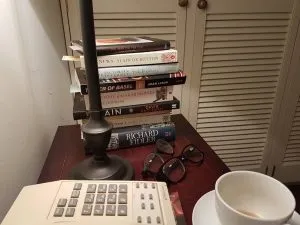
Cocozza and Runcie are mostly bagging ebooks because of those things they’ll miss when people don’t read print any more. ‘There’s no romance’; ‘Books do furnish a room’; ‘An ebook isn’t a friend’. Frankly I sympathise here. (My bedside table is stacked with printed books with bus tickets and things acting as bookmarks.) But not to the point where I think this whining actually makes much sense.
It’s a ledger. On the left, the benefits; on the right, disadvantages. And then it’s a personal choice.
Here’s a list that opens Cocozza’s piece:
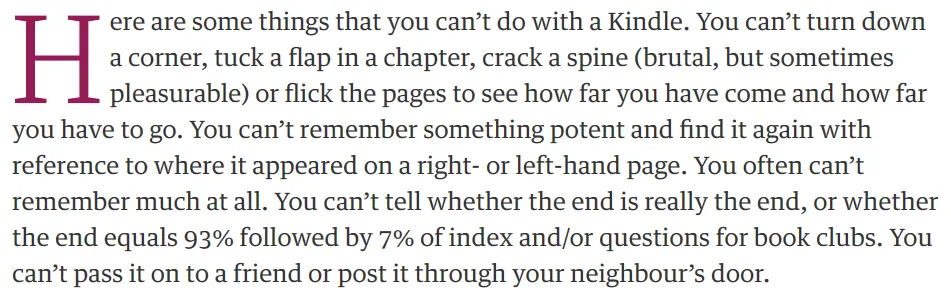 Cocozza’s list is a good one. It amounts to a challenge to us, the ebook people, to improve the experience of reading ebooks.
Runcie’s list of 10 sucky things about ebooks is more problematic. It’s hard to respond to criticisms like, ‘Ebooks are no good in the bath’, ‘Instant gratification is overrated’ or ‘Bookshops are wonderful places’.
This flurry of anti-ebook sentiment is really a claim that it is these perceived deficiencies of ebooks that caused the recent decline in consumer ebook sales. That decline provides comfort and vindication to those who hated ebooks anyway; who will always hate them for silly, nostalgic reasons.
The decline has more to do with market saturation and technical deficiency than screen fatigue. The consumer ebook market will inevitably find a stable level and resume steady growth, for many reasons. But that growth can and will be accelerated by improving the user’s experience.
In the end, even though I doubt we’ll get around to making ebooks smell like binding glue, ebooks will win; for the reasons I’ve gone into previously.
Is the ebook fad over?
Pfft. Hardly. You wish.
Two things: Last year’s decline in sales has been exaggerated in the press; and there’s a good reason why ebook adoption is taking a breather right now.
Look at the headline to Sweney’s piece: UK ebook sales plunge 17%. Actually, no. As he cites elsewhere in the report, overall ebook sales were down by 3%. That 17% figure related to an important subset of overall sales, namely consumer books — fiction, popular biography, self-help and so on. In fact, the remainder of the ebook market, including scholarly, scientific, professional and educational titles, continued growing.
There’s a kind of logic to this. Scholarly, scientific, professional and educational titles are naturally at home on a desktop. But for leisure reading, it’s a bigger, more fundamental shift for the reader.
So, really, the news here is that consumer book sales have dipped.
That isn’t really news because I and others predicted there would be an exhaustion gap following years of stupendous, saturation marketing of the Kindle platform.
There had to come a time when all those uncles and grannies who’d been given gadgets by well-meaning friends would quietly tuck them away and return to printed books.
But underneath the drooping consumer ebook trend-line there’s a steadily rising core of real ebook people who have embraced digital reading for the right reasons, for their own reasons. This cohort is growing. I know this because I’m at the coal face. We’re engaging with our customers, new and old, all day, every day.
So, here’s a stat that was mentioned in the PA report but was largely passed over:
After just 10 years, digital sales now account for 35% of total book sales revenue
This simple fact amounts to a revolution.
The ‘screen fatigue’ hypothesis
The PA’s Stephen Lotinga cites ‘screen fatigue’ as one reason for the decline in consumer ebook sales. This term, sometimes called digital fatigue, has various meanings and a tenuous connection with lived experience. It might relate to eye strain, or just a general sense that you’re spending too much time looking at screens of various kinds.
Last June, Publishers Weekly suggested that screen fatigue might be behind the decline in consumer ebook sales, citing a report by the Codex Group which showed that younger readers were drifting back to paper faster than older readers.
It’s a risky business taking consumers’ statements of intent at face value. When directly asked, they might say that they pine for the fjords and meadows and yearn to be unshackled from their screens. But look at them. Just look. In cafes, cars and emergency wards, on footpaths, boats and massage tables they’re all looking at their phones. And smiling.
Don’t talk to me about screen fatigue.
Technical Shortcomings
In a thoughtful analysis of the same Codex report argues that the decline has more to do with technical deficiency that screen fatigue, and I am inclined to agree.
The consumer ebook market will inevitably find a stable level and resume steady growth, for many reasons. But that growth can and will be accelerated by improving the user’s experience.
Let’s face it. E-Paper isn’t black-and-white — it’s grey on grey. It just is. Flipping through a printed book to find something is just easier/better/nicer than sliding your finger back and forth along a tiny status bar.
The frustrations expressed by Runcie and Cocozza are real. There’s still no end to little irritations in reading ebooks but, with time and focus and resources, they will be mitigated. And ultimately, through incremental improvements, reading ebooks will be better than reading printed books in every way. Apart, perhaps, from the smell of horse glue.
Stephen Cole
CEO