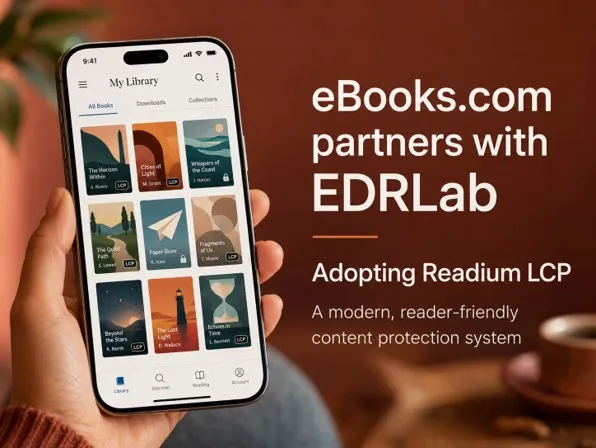
- eBooks.com is partnering with EDRLab to use Readium LCP, a modern content-protection system for ebooks.
- LCP helps protect publishers’ and authors’ rights while offering readers a simpler, less frustrating experience.
- Unlike older DRM systems, LCP is designed for an open, interoperable ebook ecosystem rather than locking readers into one proprietary platform.
- The move supports eBooks.com’s broader investment in better reading technology, including our new online reader, mobile apps and Thorium Reader support.
We’re pleased to announce that eBooks.com has partnered with EDRLab to adopt Readium LCP, a modern, elegant and interoperable content-protection system for ebooks.
For many years, ebook retailers, publishers, libraries and readers have had to work within a digital rights management landscape that has often felt unnecessarily complicated. Traditional DRM systems have helped publishers protect their content, but they have also introduced friction for readers: extra accounts, confusing authorisation processes, software limitations, and too many moments where the technology gets in the way of simply opening a book and reading.
The industry can do better.
Readium LCP — Licensed Content Protection — is a 21st century approach to protecting digital books. It has been developed for the modern ebook ecosystem: one in which readers expect to move easily between devices, publishers need dependable protection for their intellectual property, and reading systems must support accessibility, usability and long-term interoperability.
By working with EDRLab, eBooks.com is joining a community of like-minded ebook vendors, technology providers, publishers and reading-platform developers who believe that content protection should be secure, practical and reader-friendly.
Why this matters
LCP is designed to protect digital publications without locking readers into a single proprietary ecosystem. That is important.
A healthy ebook market depends on openness and interoperability. Readers should be able to buy books from trusted retailers and read them using high-quality reading software. Publishers should be able to protect their works without forcing customers through outdated or confusing technical processes. Retailers should be able to innovate, improve accessibility and deliver better reading experiences without being constrained by legacy systems.
LCP helps make that possible. It supports modern ebook formats, including EPUB and PDF, and is designed to work across a distributed ecosystem of vendors and reading applications.
For readers, this means a smoother path from purchase to reading.
For publishers, it means robust protection that is aligned with current standards and modern reading technology.
For the wider industry, it means a practical alternative to older models of ebook DRM.
A better experience for readers
Our first priority is always the reader.
Customers who buy ebooks from eBooks.com should be able to access their books with as little friction as possible. They should not need to understand the history of ebook DRM, or know which vendor owns which authorisation system, or create unnecessary third-party accounts just to read a book they have bought.
LCP gives us a path toward a cleaner and more intuitive experience.
It also fits naturally with our broader investment in new reading platforms. eBooks.com has recently been modernising the way customers read: through our new online reader, our new mobile apps, and our support for Thorium Reader on desktop.The adoption of LCP is part of the same programme of work: making ebook reading simpler, more reliable, more accessible and more pleasant.
A responsible approach to publisher protection
We understand why publishers require content protection.
Authors and publishers invest heavily in creating, editing, producing and distributing books. They need confidence that their titles can be sold digitally in a way that discourages unauthorised sharing and protects commercial value.
LCP allows us to meet that need while also improving the customer experience. It is not a rejection of content protection. It is a better implementation of it.
For publishers, this means eBooks.com can continue to support secure digital distribution while moving toward a more modern, standards-based ecosystem. For customers, it means fewer barriers and a clearer, more reliable reading experience.
Supporting accessibility and modern reading standards
Accessibility is central to the future of digital reading.
Ebooks should be usable by as many people as possible, including readers who rely on assistive technologies, custom display settings, text resizing, screen readers, keyboard navigation, or other accessibility features. Content protection should not prevent legitimate readers from using the tools they need in order to read comfortably.
This is one of the reasons we are enthusiastic about EDRLab’s work. EDRLab has played an important role in advancing open standards, accessible reading systems and modern ebook infrastructure. Its work on Readium, Thorium Reader and LCP reflects a vision of digital reading that is open, accessible and built for the long term.
That vision aligns closely with our own.
Collaboration across the ebook ecosystem
We are delighted to collaborate with EDRLab and with other ebook vendors who are adopting LCP.
The ebook industry is at its best when retailers, publishers, libraries, technology providers and standards organisations work together. No single company should have to define the future of digital reading alone. Interoperable systems, shared standards and practical collaboration are essential if the industry is to provide readers with better alternatives.
By adopting LCP, eBooks.com is supporting that collaborative approach. We see this as part of a broader movement toward ebook systems that are less fragmented, less frustrating and more capable of serving readers and publishers alike.
Looking ahead
The adoption of LCP is an important step in eBooks.com’s continuing work to improve the reading experience for our customers.
It sits alongside a wider programme of product improvements, including our online reader, mobile reading apps, desktop reading support and our continued focus on accessibility and reliability.
Our goal is simple: to make it easier for people to buy, open and enjoy ebooks.
We are grateful to EDRLab for its leadership, and we are pleased to be part of an ecosystem that is working toward a better future for digital reading.
